
We are pleased to share with you this interview with Frédéric Meuwly for La Fabrique de l'Agilité. In this short video, Frédéric talks about how to reconcile agility and sustainability in a complex world.
Why do we seek to be agile?
We seek to be agile, particularly to manage a complex, sometimes disruptive, or even chaotic environment.
In this type of complex environment, it is difficult to have all the answers alone: hence the interest in working in a network, which allows for exchanging, finding solutions, sharing resources and generating collective intelligence.
Agility and sustainability: can the two be reconciled?
When we talk about’agility we are talking more about a short time and when we address sustainability we are rather evoking a long time; and yet it is possible to reconcile the two.
So how can we develop sustainable teams when we are precisely asked to be agile and reactive to face changes in our environment?
“A sustainable team will implement a series of practices that will allow it to reconcile the challenges related to the short term, i.e. agility; and the long term, sustainability; by making what are called conscious choices.”
The team will rely on the 18 key factors to reduce complexity and make conscious choices in an agile way. These conscious choices will allow the team to find a form of coherence and alignment between the short term and the long term to enable it to navigate complexity, adapt to its environment and evolve sustainably.
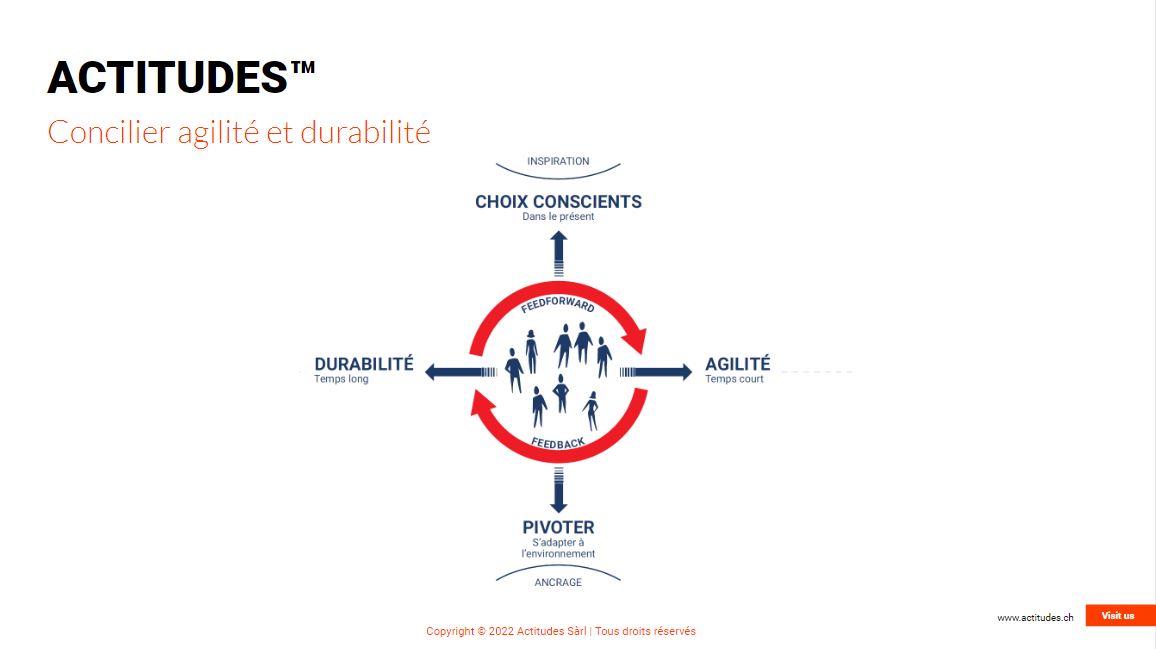
This is precisely what characterizes and differentiates sustainable teams: it is their ability to constantly pivot in the present to quickly adapt to changes in the environment, while avoiding making decisions that are too short-sighted and that could be counterproductive in the long term.
What will be one or more of the emblematic practices of agile organizations in the future?
An agile practice of the future that is already happening is related to communication and the ability to give and receive feedback dynamically. To adapt to changes, perceive changes in the environment; communicate about the responses we will give to change as an organization. It's all at once: how to intensify communication flows while avoiding over-communication.
This goes hand in hand with finding more distributed organizational models, more participatory governance models, and leadership postures that are conscious and allow for conscious choices in a complex environment.

Discover the book Sustainable Teams
This practical guide will allow you to sustainably transform the cohesion and collective performance of teams within your organization thanks to the 18 key factors for effective teamwork.
