
CHF 0.00 0

Panier

No products in the cart.

Why it's important

Teams are obliged to simultaneously manage their operational environment, their stakeholders, potential threats, their own flaws and vulnerabilities. Risk assessment must take into account probabilities of occurrence and potential repercussions. From there, it is possible to develop a preventive strategy. Experienced teams always keep an eye on stakeholders and risks, and this dual monitoring is essential for the success of any collective operation.
Some ideas for developing this dimension with your team

Things to do

  • Use a combination of tools and methods to mature your strategic thinking, structure your information, and prioritize your actions. I particularly recommend brainstorming sessions, analyses
    SWOT (Strengths, Weaknesses, Opportunities, Threats), risk assessment grids, event chain methodology, and other statistical tools related to financial asset valuation.
  • Document risks in a specific register. Specify their nature, their degree of probability, their possible impacts, associated weighting measures, etc. These details are generally recorded in a
    grid or a table.
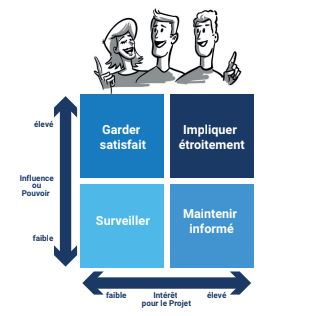
  • Create a special grid for the power and interest level of your stakeholders. In the diagram below, they are divided into four categories (or quadrants) that show how you can interact with and influence them:
  • Establish a communication plan to determine what information you will give to your stakeholders and when. These announcements can be, for example: news on project progress, interim results, risks and opportunities, changes in perspective, delays. Be honest in your communication and realistic in your promises. The quality of your relationships with your partners depends on it.
  • Address stakeholder and risk management proactively. Conduct regular check-ins. This monitoring should be among your team's priorities, along with action plan follow-up. Do not merely agree to this task to ease your conscience while waiting for the next audit.

What to avoid

  • Limit an activity to the management cockpit. This would deprive you of your team's collective intelligence. Furthermore, individuals might not feel sufficiently legitimate and empowered vis-à-vis their stakeholders.
  • Pseudo-improvements that amplify risks. The paths to operational efficiency and lean management are fraught with pitfalls. For example, the pursuit of excellence can, in the long term, harm processes, roles, and the people themselves, leaving your organization weakened, or even destitute.
  • Forgetting what you especially should not do in risk management. Action is often preferable to inaction, that's for sure. Nevertheless, certain steps or activities can intelligently be eliminated with a view to risk reduction. Deliberately choosing not to act can therefore prove worthwhile.
  • Neglecting the human aspect and other psychological factors. People's attitude towards risk obviously depends on their own situation, but not only. Not everyone has the same tolerance threshold for uncertainty, for example. So don't focus too much on the mathematics of risk: you would miss some more subtle aspects of the scenario.
  • Anticipating the future based on past events. Do not make precedents a systematic rule. It is better to rely on current elements to develop risk mitigation strategies.

Share this page

Let's talk together

Leave us your contact details and we will get back to you as soon as possible.