CHF 0.00 0

Panier

No products in the cart.

Why it's important

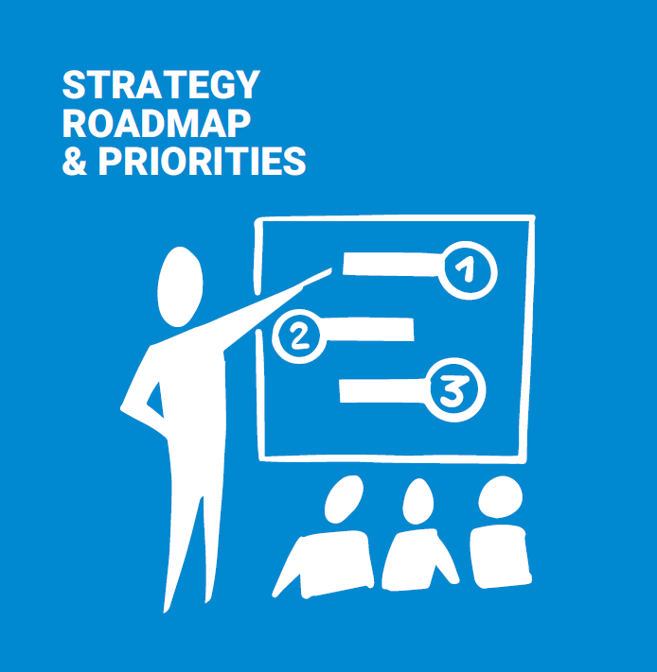
In our environment characterized by great lability (remember the VUCA acronym…), organizations must not only rethink their strategy, but also their way of conceiving it. In this context, a clear and viable strategy constitutes a major asset, an anchor point for your strategy to continue producing value. Let us note, however, that this approach is becoming increasingly dynamic, agile, and contextual, precisely because of the unpredictable evolution of our environment. Consequently, organizations that maintain too rigid an approach to their strategy are particularly vulnerable to disruptions.

Some ideas for developing this dimension with your team

Things to do

  • Federate all your stakeholders: staff, customers, board members, advisory committees, authorities, external consultants, etc. This rallying will earn you support that will eventually spare you political pitfalls. This will also be useful for identifying your customers' needs and sniffing out new trends.
  • Use a modular approach, based on scenarios, to test and compare various options before setting your strategy. Make sure you have thoroughly assessed the risks. Teams and their stakeholders must have a common understanding of this strategy before moving to the implementation phase.
  • Demonstrate agility in deploying your strategy. Conduct regular reviews. Your roadmap and priorities must be constantly adapted to circumstances. Communicate any adjustments to your stakeholders – internal and external – without delay.
  • Diagram your strategy in a visual roadmap highly elaborated. This document ideally fits on one page. With explicit and concise content, it will be more effective than a Gantt chart for mobilizing people around a common strategy, because it will be easier to read. Thus, your strategy will have the best chances of being understood and applied throughout the organization.
  • Deploy your strategy in real time, in a participatory mode. Record the key elements of your roadmap on a collaborative digital platform. Latest generation software64 dedicated to strategic decision-making allows mapping all parameters (e.g., issues, risk factors) and tracking the flow of actions in real time.

What to avoid

  • Rely on assumptions or intuitions to develop a strategy. If you have relevant data, use it to update your knowledge and further refine your strategy. Teams should seek to gather as much information as possible (for example, via platforms specialized in real-time marketing analytics that allow, thanks to the Internet of Things, to understand how connected services are used by customers).
  • Entrust the preparation of your strategy to only a few people, sometimes exclusively to external consultants. As already mentioned, it is preferable to proceed collaboratively, actively engaging teams. Not only will you leverage their collective intelligence, but you will also gain their buy-in more easily. Which will greatly facilitate what follows…
  • Congratulate oneself without questioning the previous plan. Don't fall into complacency. Even if you've had an excellent year and your overall objectives remain the same, take the time to re-evaluate them in light of current events. Don't run the risk of being caught out by reality.
  • Developing a plan disconnected from your organization's reality. I advise you to start by reviewing your team's skills, resources, and capabilities (human and financial). Then, check that you have the necessary budget to implement your plan, taking into account the potential recruitment of new talent or the purchase of new systems. The way you intend to address any identified shortcomings must not be vague.
  • Clinging too firmly to the plan. High-performing teams know how to react quickly when it's imperative. They also demonstrate good iterative capabilities, implementing review and learning cycles to constantly adjust their strategic direction. Furthermore, they skillfully combine various tools (for example, performance indicators and dashboards) to measure progress and manage feedback during the implementation phase.

Share this page

Let's talk together

Leave us your contact details and we will get back to you as soon as possible.