
The company represented as a living organism: understanding the interdependence of the 18 key factors in the company's ecosystem.
You already know the 18 key factors for effective teamwork if you have read the book “Sustainable Teams” or participated in one of our workshops. In this video, Frédéric goes further and explains to us the interdependence and interactions of these key factors within the company.
Frédéric Meuwly suggests linking the functioning of the company with the functioning of a living organism, here the functioning of a tree.
This figurative way of representing the 18 key factors allows us to understand these 18 factors as well as their function in the company's ecosystem and their interactions with the whole.
This video is an excerpt from our online training Sustainable Teams: 18 key factors for effective teamwork : which is now also available in English! And to which you are welcome if you wish.
THE INTERDEPENDENCE AND INTERACTIONS OF THESE KEY FACTORS WITHIN THE COMPANY
“Some factors pull this tree upwards and give it meaning, a direction; other factors constitute its base, its roots and the healthy soil the tree needs to develop.”
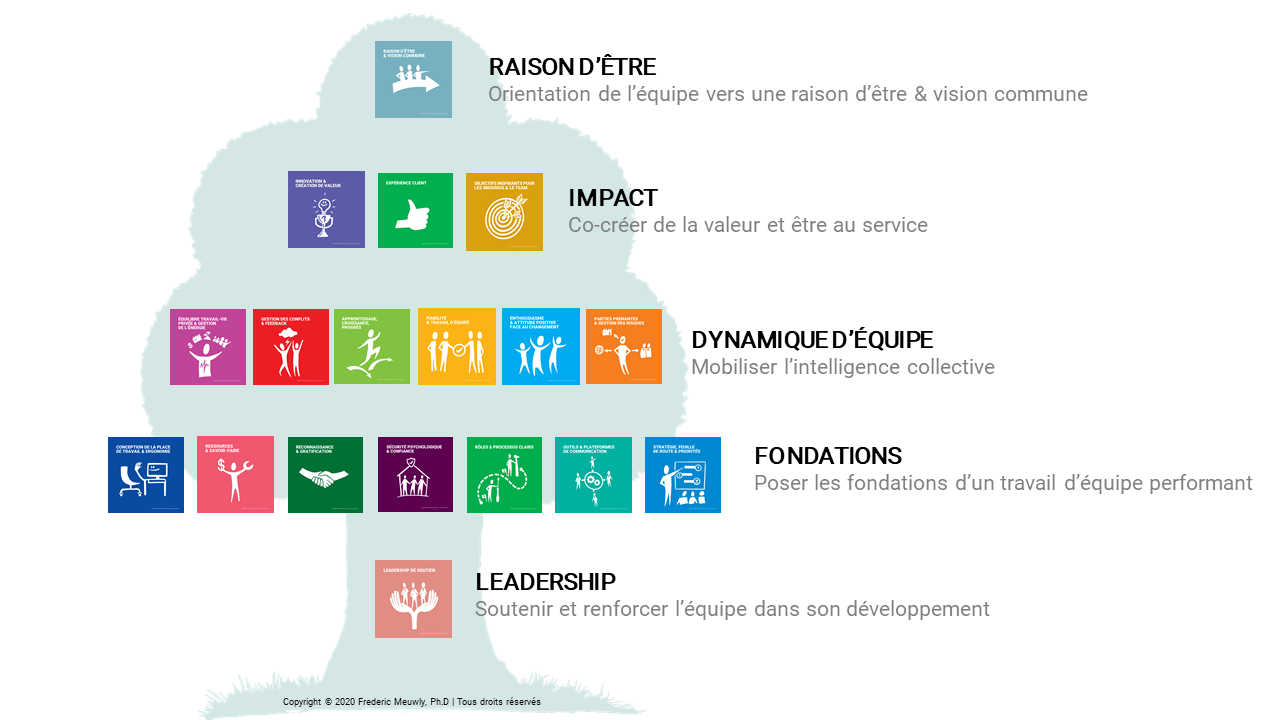
At the center of the tree, we will find factors concerning team dynamics : these factors will give life to the team, much like the sap that circulates and connects the bottom and top of this tree and allows for dynamic management of the whole.
DIRECTION, MEANING AND COMMON VISION
At the very top of this tree, much like the star on top of a Christmas tree, we find the vision, mission and purpose of the team ; this is what will give meaning, a direction to the team and unite it around a common vision.
IMPACT
Just below the purpose, we find three factors related to impact and value creation: customer orientation at the center because a team is always at the service of someone or something beyond the team; whether it's a client, a user of a public service, or a community.
Right next to it we find innovation and value creation because the team will always seek to improve its impact and co-create value within its ecosystem.
The team will then translate this into the form of individual and collective objectives. These objectives should be inspiring because they are directly linked to the team's meaning and mission and will allow for the concretization of how the team will co-create value and have a positive impact for the community of users it serves.
SUPPORTIVE LEADERSHIP PROVIDING THE «FERTILE GROUND» THAT ALLOWS THE TEAM TO GROW AND EXPRESS ITS FULL POTENTIAL
If we now look at the foundations of this tree, we find at the very bottom, much like the trunk, the roots, the notion of supportive leadership. It's like in the model of Servant Leadership by Robert Greenleaf where leadership is not at the very top of the pyramid above its teams but we see it rather as an inverted pyramid where the leader's role is above all to strengthen, to support the team.

“ Leaders are like gardeners whose mission is to ensure that the team has healthy and fertile ground to develop and express its full potential. This supportive leadership will therefore ensure the implementation of solid foundations to ensure high-performing teamwork.”
SOLID FOUNDATIONS
Among these foundations are elements such as the design of workspaces, resources and know-how ; the positive reinforcement through recognition and gratification and the notion of psychological safety and mutual trust which will be essential for the proper functioning of a team.
Still within these foundations, we also find more operational dimensions such as having clear roles & responsibilities and processes, notably decision-making processes, platforms and modes of communication and coordination that are effective, and finally, strategic management and priority arbitration.
TEAM DYNAMICS: EMERGENCE OF A LEARNING CULTURE AND EFFECTIVE COLLABORATION
“Once these fundamentals are in place, a real learning organization culture and effective collaboration will be able to emerge.”
We will then be able to authentically practice the feedback culture to proactively manage conflicts and express individual needs to effectively manage energy and work-life balance specific to each team member; which is essential for maintaining long-term commitment and motivation.
The team will also be oriented towards external elements with a dynamic stakeholder risk management and an openness to changes induced by these stakeholders.
TEAM COHESION AND PERFORMANCE
During our team cohesion and performance programs, these 18 key factors allow the team to’fully access collective intelligence of the group and focus its energy on what it can impact. The team thus learns to “play to win” while pursuing collective goals. Do not hesitate to contact us if you wish to organize such a program with your team.
ONLINE TRAINING “SUSTAINABLE TEAMS”
We hope that this overview of the 18 key factors for effective teamwork has been useful to you. In parallel, we invite you to join us in the complete online training if you wish to conduct a more in-depth reflection on where your team stands today and how to support it towards greater sustainability and performance.

Join the online training Sustainable Teams
This program will allow you to discover the 18 key factors for sustainable teams and will give you tools to implement them within your organization.
THE 18 KEY FACTORS FOR HIGH-PERFORMING TEAMWORK FROM 1 to 18
And just for the record, here are the 18 key factors from 1 to 18: These key factors are also the categories for our articles in this Blog: Happy browsing and see you soon!
- Purpose & common vision
- Innovation and value creation
- Customer experience
- Inspiring goals for individuals and the team
- Work-life balance & energy management
- Conflict management & feedback
- Learning, growth, progress
- Reliability & teamwork
- Enthusiasm & positive attitude towards change
- Stakeholders & risk management
- Workplace design & ergonomics
- Resources & know-how
- Recognition & gratification
- Psychological safety & trust
- Clear roles & processes
- Communication tools & platforms
- Strategy, roadmap & priorities
- Supportive leadership

Discover the book “Sustainable Teams“
This practical guide will allow you to sustainably transform the cohesion and collective performance of teams within your organization thanks to the 18 key factors for effective teamwork.
