Teams need new integrated, pragmatic, and concrete tools to manage the complexity of their work context and to develop and maintain high-performing teamwork in the long term. |
|
These new support approaches have become necessary because teams today operate in a work environment that is increasingly Volatile, Complex, Uncertain, and Ambiguous, and we speak of a VUCA environment to represent this reality. |
|
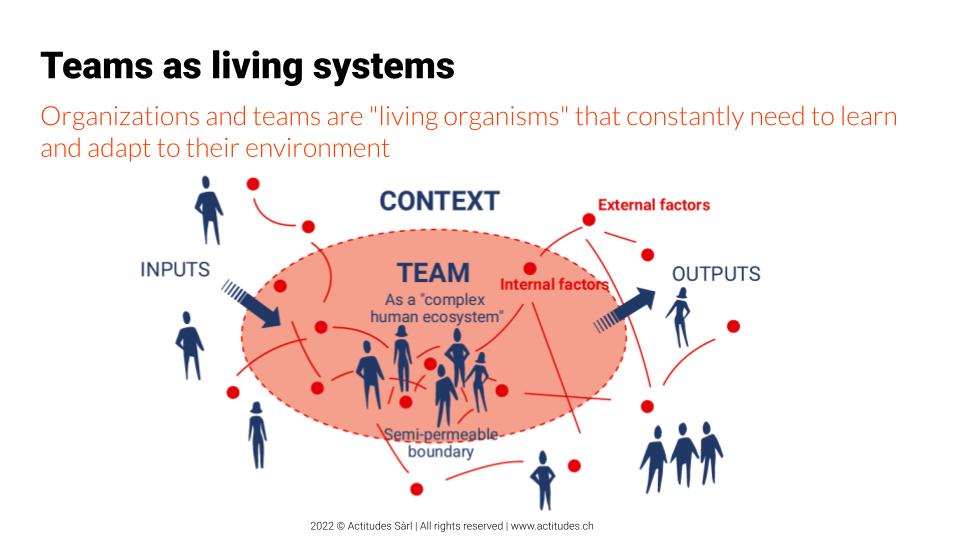
In fact, organizations themselves are complex systems. If we compare them by analogy with living systems, the proper functioning of the organization as a whole (the organism) will depend on the good health of its different organs (departments) and ultimately of each small cell (the teams and individuals) that constitute this organization.
This visual represents the team as a cell surrounded by a semi-permeable membrane, and its main challenge will be to constantly manage bidirectional interactions with its environment, the numerous incoming/outgoing factors, and all their interconnections and interdependencies between these factors and the people involved inside and outside the team. |
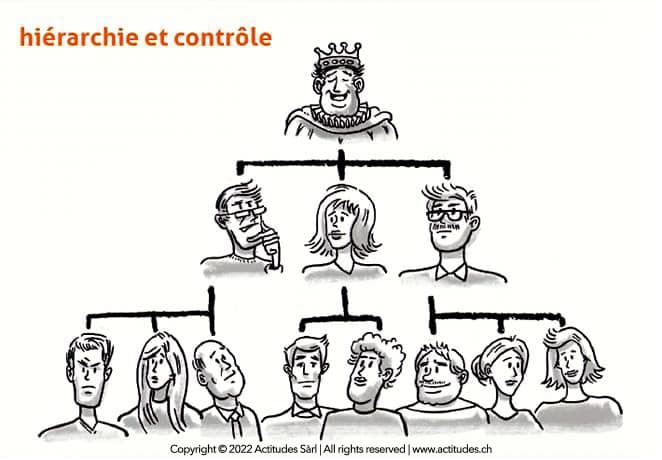
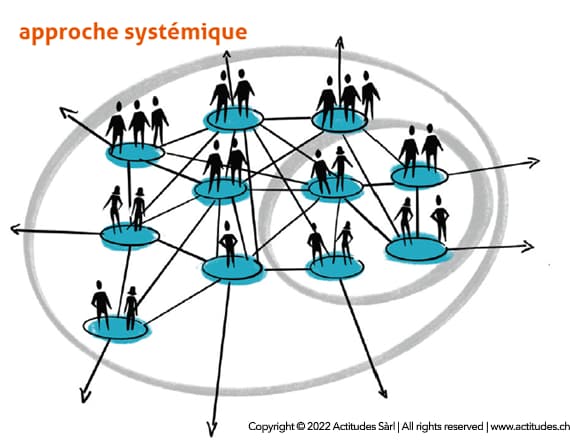
We realize that it is impossible to “control” such a complex system, and for this reason, old hierarchical management methods are gradually being replaced by new, more distributed and participatory organizational models that follow a systemic logic.
|
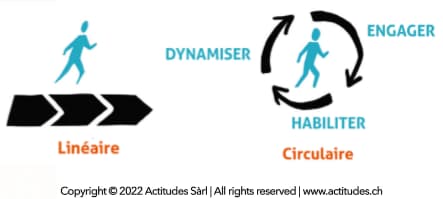
For the same reasons, we observe that project management is no longer done in a sequential and linear manner but rather with agile methods adapted to a more “circular” mode of operation.
|
So how can we develop sustainable teams when we are precisely asked to be agile and reactive to face changes in our environment? |
|
“A sustainable team will implement a series of practices that will allow it to reconcile the challenges related to the short term, i.e. agility; and the long term, sustainability; by making what are called conscious choices.” |
The team will rely on these 18 drivers to reduce complexity and make conscious choices in an agile way.These “conscious choices” will allow your team, in a way, to find a form of consistency and alignment between the short term and the long term which allows it to navigate this complexity to adapt to its environment and evolve sustainably. And this is precisely what characterizes and differentiates sustainable teams: it's their ability to constantly “pivot” in the present to quickly adapt to changes in their environment while avoiding making overly short-term decisions that could be counterproductive in the long term. |
|
Here are 3 main points to remember about sustainable teams:
|
|
To access this complete online training program "Sustainable Teams and the 18 Factors " it's here: |