Le développement de notre approche d’accompagnement des ’“équipes durables” est parti d’un constat : les équipes ont besoin de nouveaux outils intégrés, pragmatiques et concrets pour gérer la complexité de leur contexte de travail actuel et arriver à développer et maintenir un travail d’équipe performant sur le long terme. |
|
Ces nouvelles approches d’accompagnement sont devenues nécessaires car les équipes évoluent aujourd’hui dans un environnement de travail qui est de plus en plus Volatile, Complexe, Incertain et Ambigu, et on parle d’environnement VUCA pour représenter cette réalité. |
|
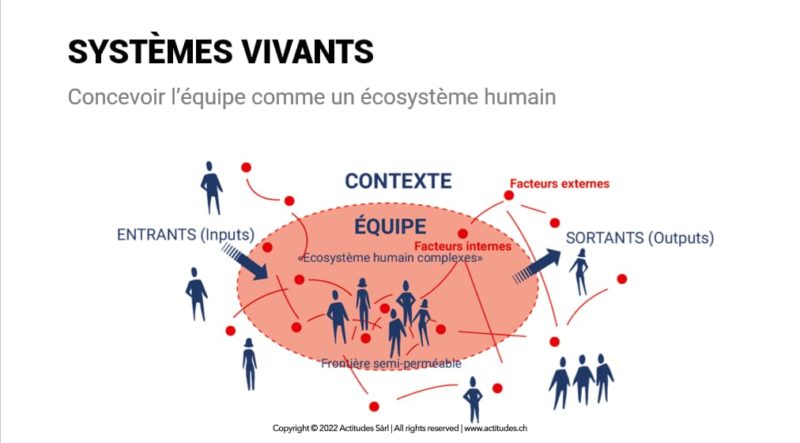
En fait, les organisations sont elles-mêmes des systèmes complexes. Si on les compare par analogie avec les systèmes vivants, le bon fonctionnement de l’organisation dans son entier (l’organisme) va dépendre de la bonne santé de ses différents organes (départements) et in fine de chaque petite cellule (les équipes et les individus) qui constituent cette organisation.
Ce visuel représente l’équipe comme une cellule entourée d’une membrane semi-perméable et ont principal défi va être de gérer en permanence les interactions bi-directionnelles avec son environnement, les nombreux facteurs entrants/sortants et toutes leurs interconnections et interdépendances entre ces facteurs et les personnes impliquées à l’intérieur et à l’extérieur de l’équipe. |
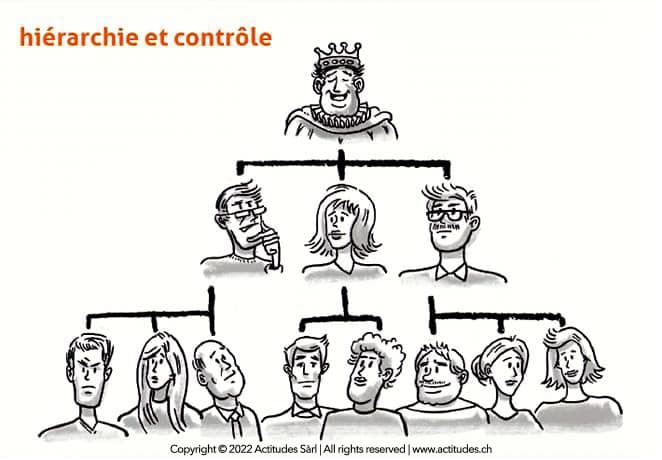
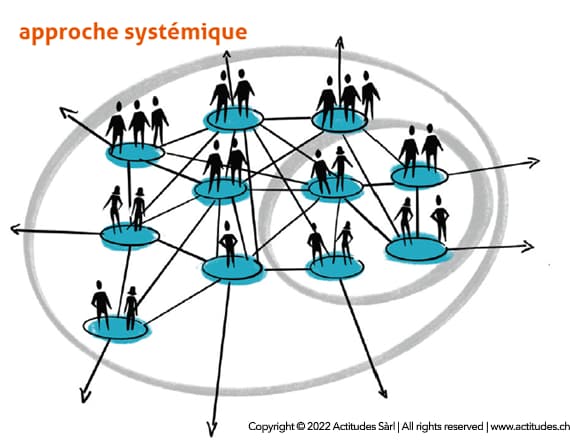
On se rend bien compte qu’il est impossible de “contrôler” un tel système complexe et pour cette raison que les anciennes méthodes de management de type hiérarchiques sont progressivement remplacées par de nouveaux modèles d’organisation plus distribués et participatifs qui suivent une logique systémique.
|
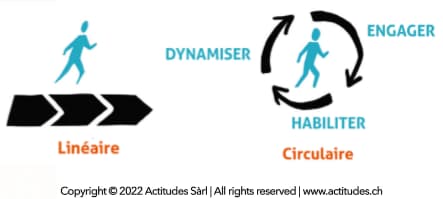
Pour les mêmes raisons, on observe que la gestion de projet ne se fait plus de manière séquentielle et linéaire mais plutôt avec des méthodes agiles adaptées à un mode de fonctionnement plus “circulaire”.
|
Une question que l’on me pose souvent : comment réussir à développer des équipes “durables” alors que l’on nous demande justement d’être de plus en plus “agiles” et réactifs pour faire face aux changements rapides dans notre environnement ? |
|
En fait, une équipe durable va mettre en place une série de pratiques qui vont lui permettre de concilier les enjeux liés au temps court (l’agilité) et au temps long (la durabilité) en faisant ce que l’on appelle des “choix conscients”. |
L’équipe va s’appuyer sur ces 18 facteurs clés pour réduire la complexité et faire des choix conscients de manière agile.Ces “choix conscients” vont permettre à votre équipe en quelque sorte de trouver une forme de cohérence et d’alignement entre le temps court et le temps long qui lui permet de naviguer dans cette complexité pour s’adapter à son environnement et évoluer de manière durable. Et c’est justement cela qui caractérise et qui différencie les équipes durables: c’est leur capacité à “pivoter” en permanence dans le présent pour s’adapter rapidement aux changements de leur environnement tout en évitant de prendre des décisions trop court-termistes qui risqueraient d’être contre-productives à long terme. |
|
Voici 3 points principaux à retenir sur les équipes durables :
|
|
Pour accéder à ce programme de formation en ligne complet "Les équipes durables et les 18 facteurs " c'est par ici: |